Wednesday, April 27, 2011

Why Home Depot Struggles and IKEA Thrives in China?


At a time when China’s home furnishings market surged 17 percent, the largest U.S. home improvement company Home Depot has been struggling and closed five stores since it entered the China market in 2006.

Analysts pointed to the fact that a “do it yourself” culture does not exist in China. True.  Because labor costs are relatively low, many homeowners would rather hire someone to do the work than do it themselves. Apparently, Home Depot made the same mistake as some other companies that entered China without understanding the local market, which is often dramatically different from their home market.

Unlike consumers in the West, Chinese consumers have no role model from older generations. Home ownership was non-existent about fifteen years ago. It was then very common for a family, sometimes three generations, to share a 300-square-feet room that they used for sleeping, eating and daily activities. A kitchen was not even a necessity as many people simply cooked in a common area outside their room.

In the last fifteen years, home ownership has gone from practically zero to about 70 percent. However, many people have little sense of how to furnish or decorate a home.  They are very eager to learn from the West. This is one of the reasons that IKEA is very popular in China. Their Western-style showrooms provide model bedrooms, dining rooms, and family rooms showing how to furnish them. Their stylish and functional modern furniture is particularly appealing to young couples.

I visited IKEA in Shanghai. The 360,000-square-foot store was packed with people shopping for furniture and household appliances for their new homes. The store offers more than seven thousand products and features a five-hundred-seat restaurant and a spacious and colorful children’s playground. Some people come to IKEA to experience the Western style of living, or simply for recreation, as if it were a theme park.
While Home Depot reduced its stores in China from twelve to seven, IKEA plans to double the number of its stores from its current eight to fifteen by 2015. In a country where millions of new home owners are added each year, companies cannot afford to lose this potentially huge market. Here are some important lessons that we can draw from the Home Depot case:
    * Chinese consumers need to be educated as they have no role models. They are eager to learn but they need guidance. Companies that invest in educating the market can expect to reap handsome rewards.

    * Pay attention to local customers’ preferences. For example, the kitchen is usually small and considered secondary in a Chinese home. Chinese cooking usually blackens the kitchen with soot and grease and is the domain of an ayi, or household helper, who cooks for the family.

    * Most Chinese homeowners live in condominiums rather single family homes. They do not have a garage that can store tools and ladders. A more appealing package would be pre-designed interiors with installation included.

Since the Chinese consumer market is new and still emerging, companies have an opportunity to rebrand their products and services. For example, GM China has done a better job of truly listening to customers than GM North America has. Many middle class Chinese like to drive their parents around on weekends and some can afford to hire chauffeurs. GM’s Cadillac SLS model addresses the needs of the Chinese market for a roomy, luxurious back seat for chauffeur-driven riders.

In order for companies to succeed in a new market, it’s critical that they study the market and adapt to local conditions. It is still not too late for Home Depot to turn itself around in China.

/written by Helen H. Wang, Forbes/

Friday, April 22, 2011

Real Grapes You Should Try

I always miss the grapes grown in China. They are sweet but not too sweet, with a little flower's aroma, such as roses'. The grapes, however,  I bought in the supermarkets in the United States have no taste but sweet. If you have chance to visit in China, especially during the fall season, I strongly recommend that you'd better try grapes called 巨峰葡萄,or 玫瑰香葡萄.

Thursday, April 21, 2011

The Facebooks of China

China's fake Facebooks started as mere copycats but now drive innovation in advertising and gaming. They've also built something unique in their country: a place where people can find love, speak out, and be whoever they want to be.

"Know anyone who has any needs? "
"I'm not sure, I can ask around for you."
"Don't you have any needs?"
"I just want to be with someone I love."
"Really, I'm not bad. Give it some thought."

It was the worst pickup attempt that Dong Jin had ever heard. You might think that something was lost in translation, that surely this sounds better in the original Chinese, but you would be wrong. That all this was unfolding online -- Dong, 26, a Beijing teacher, was being approached by a college student who had just friended her on the Chinese social network Renren -- made it even weirder. Scenes like this (many of them, fortunately, less awkward) repeat themselves hundreds, if not thousands, of times a day on the Facebooks of China.

The real Facebook is not available behind the Great Firewall of China, except to netizens rich enough and technologically savvy enough to buy access to proxy servers, because government censors have blocked it as a foreign threat. Twitter and Google are off-limits too.

In the absence of these web titans, dozens of Chinese copycats have sprung up, but none tell a story of evolving, modern China like the fake Facebooks, some of which mimic Facebook down to page architecture and color scheme. The leading social networks on the mainland are Renren, which, like Facebook, initially targeted the college crowd, and Kaixin001 (kaixin means "happy," and the 001 was added to give a techy feel to the name), aimed at young professionals.

In some ways, social networking in China is much like that in the U.S. It has spread well beyond its original target demographic. Office workers stay logged on constantly. Artists, singers, and secretaries post status updates a dozen times a day from their laptops or their cell phones. Grandmothers grow potatoes on local versions of FarmVille.

As with Facebook, the membership rolls are astounding and growing rapidly. In a 1.3 billion-strong nation where less than a third of the populace is online, Renren claims about 165 million users. A slogan on a chalkboard in an employee lounge at its HQ claims, "Every day the number of people joining Renren.com would fill 230 Tiananmen Squares." Kaixin001 says it has 95 million users.

In significant ways, though, online life behind the Great Firewall is different. For one thing, there is no dominant site. By blocking Facebook, the government has unwittingly ignited an especially fierce and litigious competition between Renren and Kaixin001. The two networks have pushed each other strategically and technologically, devising ingenious new ways to advertise to audiences that are even more saturated by marketing than Americans. Also, according to Netpop Research in San Francisco, Chinese Internet users are twice as conversational as American users; in other words, they're twice as likely to post to online forums, chat in chat rooms, or publish blogs. And to the joy of advertisers and marketers, social media is twice as likely to influence Chinese buying decisions as American ones, which explains why brands such as BMW, Estée Lauder, and Lay's have flocked to China's social networks.

Sites like Renren and Kaixin001 are microcosms of today's changing China -- they copy from the West, but then adjust, add, and, yes, even innovate at a world-class level, ultimately creating something unquestionably modern and distinctly Chinese. It would not be too grand to say that these social networks both enable and reflect profound generational changes, especially among Chinese born in the 1980s and 1990s. In a society where the collective has long been emphasized over the individual, first thanks to Confucian values and then because of communism, these sites have created fundamentally new platforms for self-expression. They allow for nonconformity and for opportunities to speak freely that would be unusual, if not impossible, offline. In fact, these platforms might even be the basis for a new culture. "A good culture is about equality, acceptance, and affection," says Han Taiyang, 19, a psychology major at Tsinghua University who uses Renren constantly. "Traditional thinking restrains one's fundamental personality. One must escape."

Put another way, a lot of people in China have needs -- and one of them is a place to be whoever they want to be.

Do not call Wang Xing the Mark Zuckerberg of China. Mark Zuckerberg is the Mark Zuckerberg of China. In 2003, Wang dropped out of a PhD program at the University of Delaware and returned to Beijing to create a local version of Friendster. It flopped. Two years later, he heard about this new thing called Facebook and decided to copy it.

If you want to read more, please click on Fast Company magazine at http://www.fastcompany.com/magazine/152/the-socialist-networks.html?page=0%2C1

Wednesday, April 20, 2011

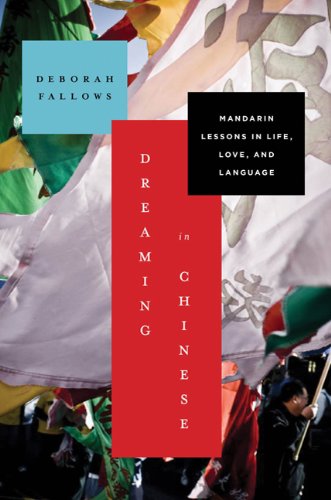
Dreaming in Chinese

I just remember the first time I heard the book Dreaming in Chinese: Mandarin Lessons in Life,Love, And Language was in the New York Time Book Review section. Since I had the similar experience when I learned English - dreaming in English. And I am curious about how an America woman learned Chinese. So I borrowed the book from the local library and read it. It turns out a very interesting reading experience.

The author Deborah Fallows came to China with her husband and has lived there for three years. She learned Chinese language and characters based on their daily life and the culture context. She mentioned Chinese Pinyin system. There are four tones in the Pinyin system. I believe that it's very confusing to foreigners. For example, 狮,十,使,是, four Chinese characters have the same basic Pinyin letters"shi". But the tones are different. 狮(lion)is with the first tone, shī, a high tone;十(ten)is with the second tone, shí, rising tone;使 (to make)is with the third tone, shǐ, falling then rising;and 是(to be)is with the fourth tone, shì, falling tone.

I think it's also confusing if you heard the word in Chinese, like xīn. It could be the word  新,which means "new", or the word 心,which means "heart". It depends on which context the word is.

When I learned the differences between English and Chinese, I figured out that there is no space between two Chinese characters, but English words do(like "新年" in Chinese, "New Year" in English. ). Ms. Fallow also pointed it out.

The most confusing thing to speak English to me is when I say he/she/it/. In Chinese, they are three different characters 他/她/它 with the same Pinyin -- tā. As a born Chinese speaker, I don't have any problem to say them and never make a mistake on the gender when I heard the word. But once I speak in English, something happened unconsciously.If I say "she", while usually have "he" in my mind. Ms. Fallows talked about this linguistic phenomenon in her book.

Besides the above, the author explained how Chinese people say the directions, how Chinese characters are composed. Anyway, there are lots of knowledge and language learning experience we can read from the book. You also will deeply understand the culture context of China. I am sure that Ms. Fallows has already fallen in love with 按摩 and 拔火罐 of China.  

The daily Chinese:
打包 (dá bāo):Do you do takeout?
很好 (hěn hǎo): Really good!
不可以 (bù kě yǐ ) : Not allowed
你好(nǐ hǎo) Hello
再见(zài jiàn) Bye Bye
厕所在哪里?(cè suǒ zài nǎ lǐ) Where is the bathroom?
谢谢!(xiè xie) Thanks

Good place look up Chinese Characters at this online dictionary 
You can find the book at amazon.com 

Thursday, April 14, 2011

Meet Joe Wong

A molecular biologist walks into a comedy club and goes onstage...

Sounds like the perfect set-up for a joke, right? But in the case of Joe Wong, it actually happened. Joe holds a Ph D in molecular biology, still works for a pharmaceutical company on cancer research and is the comedian du jour in the US, making appearances on The Late Show with David Letterman and Ellen. This March, he's headlining the Radio and TV Correspondents’ Association dinner with President Barack Obama* in the audience.

How does a scientist – they don't exactly have a reputation for comedy – decide to make people laugh? For Joe, the realization came quite late.

“I was in college in China when I wrote two sketches. I thought one of them was quite funny. I never really thought about becoming a comedian until I came to the US.”

Joe went to the US in 1994 to attend university. After the company he was working for in Texas closed its doors, Joe moved to Boston, the mecca for stand-up comedy.

“I didn't even know there was an art form called stand-up comedy until I moved to Boston in 2001. I found out that there were comedy clubs here where people could go onstage and tell jokes. I went to a couple of shows and I was addicted,” Joe said. A few months later, he was performing onstage himself.

Joe grew up in Jilin province in northeast China and discovered comedy at a young age. “I grew up in the 70s and 80s and there was very little entertainment. We didn't have a TV, so I listened to the radio a lot. The programs that I enjoyed the most are xiangsheng or crosstalk.”

Crosstalk is about as close to stand-up comedy as you can get in China. It is performed by two people, one to set up the jokes and another to deliver the punchline.

What works in America may not necessarily work in China

Joe describes his comedy as intelligent and observational. “I know a lot of ethnic comedians in America make fun of their ethnic roots – Asians make fun of Asians and Italians make fun of Italians. My comedy is slightly different. It's more about observing American culture from an immigrant's point of view.”

His ethnicity, of course, is part of the routine. “People here are not so used to seeing Asian comedians onstage. I have to say something about my heritage, otherwise, people will keep thinking about it. It's good to say something up front to make people feel comfortable. That's why when I got on Letterman, the first thing I said was 'So, I'm Irish' and basically joked about my ethnic background a little bit. People could laugh and forget about it, then I can move on with my jokes.”

As Joe found out firsthand, though, the jokes that American audience lap up won't necessarily be appreciated by the Chinese.

“I went to Beijing in 2008, which is where all the stand-up comedy happens. I performed at one of the theaters on a Sunday afternoon. I basically translated all my jokes from English to Chinese. Maybe only about two jokes got a strong response. They were play-on-logic jokes, those that don't rely on cultural context.”

In China, a joke from a hundred years ago will still be appreciated by the audience. In the US, jokes have to be new, current and very up-to-date.
One reason could be that there are differences between the American and Chinese brands of humor. Joe points out that in China, humor has more tradition. A joke from a hundred years ago will still be appreciated by the audience. In the US, jokes have to be new, current and very up-to-date. There's also more sarcasm in American humor. Plus, the audience have different expectations.

“In America, they expect stand-up comedy to be very fast-paced; they want to laugh every 10 seconds. In China, you can spend more time setting up the joke, taking your time before delivering the punchline. The audience is not in a huge hurry. They're basically drink tea and eat some peanuts while listening to the jokes.”

A constant struggle

Joe has also made his mark in China. He was on CCTV and has been featured on radio, newspapers and magazines there. His parents, who still live in China and have never been to the US, didn't see the behind-the-scene struggles that Joe faced.

“It's been eight years and a lot of hard work, especially because stand-up comedy is not as popular as it was back in the 80s. It's a labor of love; I didn't make money for years and years. A lot of times, to perform onstage at a comedy club, you have to bring your own audience. As an immigrant, I didn't know anyone in this country, so I ended up talking to people on the streets in winter, trying to convince them to watch the show. The beginning was really tough.”

Joe is currently trying to develop with other comedians a TV series that reflects Asian-American life. “If you watch all the TV shows in America, there's not a single one that's mainly about Asians in the US. In the mid-90s, there was a TV sitcom by Margaret Cho, but it was very short-lived. It's a long shot. It's very hard to get a TV deal and people tend to watch reality shows more than scripted TV shows nowadays.”

Whether he pulls it off or not, Joe will probably continue on trying to make people laugh. “I just love humor. That's kind of the way I see life. You know, in this world, we had Hitler who killed millions of people and the great humanitarian Mother Teresa. But in the end, they both died. That, to me, is the biggest joke. I'm here to harvest jokes from everyday life. That's how I see the world.”

  / Written by Geni Raitisoja /

*President Obama canceled his appearance at the event. US Vice-President Joe Biden was the guest of honor in his stead.